Wednesday, December 26, 2012

Revolution Volume I: The 1960s Counter Culture & Rise of The New Left

Source:Amazon- Roger Kimball's book.

Source:The Daily Press

“In The Long March, Roger Kimball, the author of Tenured Radicals, shows how the “cultural revolution” of the 1960s and ’70s took hold in America, lodging in our hearts and minds, and affecting our innermost assumptions about what counts as the good life. Kimball believes that the counterculture transformed high culture as well as our everyday life in terms of attitudes toward self and country, sex and drugs, and manners and morality. Believing that this dramatic change “cannot be understood apart from the seductive personalities who articulated its goals,” he intersperses his argument with incisive… 

From Amazon 

“I’m into the study of revolutions, not the coopting of revolutionary rhetoric to sell capitalist merch. I’ve cut together clips of 1960s radicals discussing the politics of their time to give young people a sense of the intense revolutionary fervor of that era. Americans today have been presented with a flattened out, cliche image of 60s radicalism and have lost any sense of just how tumultuous that period was. This is what America looks like when it’s actually working. I’ll be tracing the history of revolutionary and countercultural movements in America from the 60s to the 90s in an ongoing series of youtube clips. (I added on the Church of the SubGenius at the end but that comes much later.)”   

Source:Roger Dolittle- Dr. Martin L. King speaking at the 1963 March On Washington. Perhaps the best speech ever given in American history.

From Roger Dolittle

I believe the best way to look at the New-Left political movement and Students For a Democratic Society, which is definitely part of that movement, is to look at the Irish nationalist movement in Northern Ireland, Britain and it’s relationship with the Irish Republican Army. Or the Palestinian nationalist movement in Palestine and its relationship with Palestine and Israel. SDS aren’t Nationalists, but they were the military wing of their political movement. 

Source:Students For a Democratic Society- protesting the Vietnam War.
Radicalism is not new to America, we were founded thanks to a revolution, a revolutionary war with the United Kingdom. And I believe every generation at least in the 20th Century is different with different values from the previous generation, at least when they’re young and then perhaps moderate and become part of mainstream society as they get older and become more experienced. So it’s not radicalism that’s new to America, but perhaps each generation as their own culture revolutionary movements.

I think what’s different from the 1960s with young Baby Boomers and perhaps Silent Generation babies that were perhaps seen as the mentors and role models of the Baby Boomer Hippies and radicals, is socialism and communism and the beliefs that those things aren’t actually wrong and bad and that the Cold War, especially in Vietnam and America’s involvement there was wrong.

I believe what the young radicals in America believed was that the people who were wrong, were the American establishment which was made of Conservatives and Progressives who were seen as trying to push American liberal democracy and capitalism onto the rest of the world, especially in the third world like in Asia and Latin America.

What these young folks believed that the people who were wrong were the people who were running America and they wanted a change. And even a revolutionary change in America as far as how it was governed. And decided to speak out and organize and even use violent means to accomplish their political goals.

Friday, December 21, 2012

Foreign Affairs: Lauren C. Bell: 'Fixing the Filibuster'


Source:Foreign Affairs- a blast from the past when the U.S. Senate actually had filibusters.

"By many measures, 2012 was the U.S. Senate's least productive year in two decades. Republicans blame the Congressional Democrats. Democrats blame the filibuster. 

Obstructionism is not unique to the United States. Most parliamentary democracies, including Great Britain's and Japan's, have also faced gridlock. In 1992, the Japanese opposition tried to stall a vote on whether Japanese self-defense forces should assist UN peacekeeping missions by introducing five motions that had to be brought to a vote first. They then resorted to ushi aruki (cow-walking), or taking as long as humanly possible to make one's way from one's seat to the ballot box 20." 


"This book remedies the near-complete lack of individual senator-level data available to scholars. Moreover, the dataset that Bell compiles represents a much more comprehensive list of Senate filibusters than any that has previously been compiled. Data are available for the entirety of the period from 1790 to 2008. The text provides a fully current (through the end of the 110th Congress) list of Senate filibusters from the first recorded instance in 1790. This new list undergirds a comprehensive historical analysis of filibusters and a full exploration of both micro-level (individual senator) determinants of filibustering and macro-level (institutional) factors that affect filibustering and its consequences. Beyond compiling and sharing the raw data on who filibusters what, Bell demonstrates that senators' filibustering behavior is frequently an extension of senators' legislative behavior more generally. The book makes it clear that filibustering is simply one strategy among many that senators employ as they try to advance their sometimes competing goals of representing their constituents, serving their political parties, and crafting good legislation. Building on work by Franklin L. Burdette (1940), Richard S. Beth (1994), and Gregory Wawro and Eric Schickler (2006). Filibustering in the US Senate offers a readable, accessible analysis that clarifies the meaning of important terms and offers practical insights into the uses-and abuses-of Senate legislative procedures. The timeliness of Filibustering in the US Senate, its interesting subject matter, and the accessible nature of the analysis will appeal to general and professional readers of political studies, as well as to practitioners in government.

Source:Amazon- Lauren C. Bell's book.

From Amazon

Lauren C. Bell is Professor of Political Science at Randolph-Macon College (Ashland, VA). She holds a Bachelor of Arts degree from the College of Wooster (Ohio) and Masters of Arts and Doctor of Philosophy degrees from the Carl Albert Congressional Research and Studies Center at The University of Oklahoma. She is a former American Political Science Association Congressional Fellow on the United States Senate Committee on the Judiciary (1997-98) and a former United States Supreme Court fellow at the United States Sentencing Commission in Washington, DC (2006-07). She is the author or co-author of several books and has published single- and co-authored articles in several peer-reviewed journals, including the Journal of Politics, Political Research Quarterly, The Journal of Legislative Studies, The Journal of Public Administration Research and Theory, and Judicature." 

Source:Amazon- author Lauren Cohen Bell.

From Amazon 

As a Liberal Democrat, (meaning someone who believes in liberal democracy) I'm a big fan of checks and balances, because I never want to see one party, or one individual, or a small group of individuals, ever have so much power, that they're no longer accountable to anyone or on anything. And in many cases that's the role of the filibuster, as well as it gives individual senators the ability to not just be heard, but to get votes and perhaps even their amendments attached to major legislation. 

But I'm not an absolutist on anything and I'm not comfortable with the Senate Minority Leader being as powerful as the Majority Leader or having as much power, since the Minority Leader has fewer seats, even when he leads a large minority (like today) and generally represents fewer people and voters. 

The country is so divided politically today and for other reasons, thanks to gerrymandering in the U.S. House and a lot of those members then getting elected to the Senate and bringing their hyper-partisanship to the upper chamber of Congress. As well as so much unchecked money in the political system. 

The Senate filibuster is longer used as a check against the House or a check against absolute power. It's now used today by Senate Minority Leader Mitch McConnell and before that by Harry Reid and Tom Daschele, simply to stop and prevent legislation from even being offered and even allowing for the Senate to take up debate on legislation. It is how used to stop legislation, as well as even nominees who have bipartisan support, from even getting votes. 

The Senate should be never be like the House and perhaps vice-versa. But it needs to be a place where it can get its work done, regardless of which party is in charge. The minority party should always have minority rights to not just be heard on all legislation and nominees, but to offer and get votes on their amendments and alternatives. But at the end of the debate, when all members have been heard, when all relevant amendments have been voted on, the Senate needs to be able to act, regardless of which party is in charge and who controls The White House.

The title of Lauren Cohen Bell's book is Fixing The Filibuster. So I'm thinking she's not for eliminating it either and neither am I. But if you are going to have a cloture rule in the Senate, filibusters need to be real. That means no more votes just to end debate and when those votes fail, everyone goes home or you just have another roll call or the Senate is in recess. 

At that point, led by the Minority Leader, you should need to have 41 or more senators stays on the floor, hold the floor, and talk about pending bill on the floor. With the Majority Leader able to call for a vote to end debate lets say every hour. 

No more filibusters on relevant amendments or executive or judicial nominees, motion to proceed, relevant amendments offered by either side, etc. That way both sides are involved at the Senate will finally be able to move again, unless the minority party really wants to talk a bill to death and has 41 or more votes to do that. 

Thursday, December 20, 2012

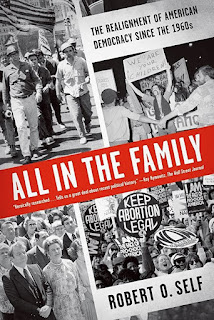
Robert O. Self: 'All in the Family: The Realignment of American Democracy Since the 1960s'

Source:Amazon- Robert Self's book.

"In the 1960s, Lyndon Johnson's Great Society and War on Poverty promised an array of federal programs to assist working-class families. In the 1980s, Ronald Reagan declared the GOP the party of "family values" and promised to keep government out of Americans' lives. Again and again, historians have sought to explain the nation's profound political realignment from the 1960s to the 2000s, five decades that witnessed the fracturing of liberalism and the rise of the conservative right. The award-winning historian Robert O. Self is the first to argue that the separate threads of that realignment―from civil rights to women's rights, from the antiwar movement to Nixon's "silent majority," from the abortion wars to gay marriage, from the welfare state to neoliberal economic policies―all ran through the politicized American family.

Based on an astonishing range of sources, All in the Family rethinks an entire era. Self opens his narrative with the Great Society and its assumption of a white, patriotic, heterosexual man at the head of each family. Soon enough, civil rights activists, feminists, and gay rights activists, animated by broader visions of citizenship, began to fight for equal rights, protections, and opportunities. Led by Pauli Murray, Gloria Steinem, Harvey Milk, and Shirley Chisholm, among many others, they achieved lasting successes, including Roe v. Wade, antidiscrimination protections in the workplace, and a more inclusive idea of the American family.

Yet the establishment of new rights and the visibility of alternative families provoked, beginning in the 1970s, a furious conservative backlash. Politicians and activists on the right, most notably George Wallace, Phyllis Schlafly, Anita Bryant, and Jerry Falwell, built a political movement based on the perceived moral threat to the traditional family. Self writes that "family values" conservatives in fact "paved the way" for fiscal conservatives, who shared a belief in liberalism's invasiveness but lacked a populist message. Reagan's presidency united the two constituencies, which remain, even in these tumultuous times, the base of the Republican Party. All in the Family, an erudite, passionate, and persuasive explanation of our current political situation and how we arrived in it, will allow us to think anew about the last fifty years of American politics." 

From Amazon 

"Robert Self, Author, "All in the Family: The Realignment of American Democracy Since the 1960's" 

Source:C-SPAN- Robert Self talking about his book.

From C-SPAN

Just to talk about Robert Self's political labels first and then I'll get into the sitcom All In The Family and it's impact on American culture: 

If you were to listen to Robert Self, you would think that Liberals are people who want to transform the American economy and bring European economics and political culture to America. Even the economic system that's based on a universal welfare state, is called social democracy everywhere else, at least in the developed world and Liberals everywhere else are considered center-right everywhere else, because they're not collectivists and big believers in individual liberty, which is what liberal is actually about. 

But in America, even terms like social democrat, let alone democratic socialist or just socialist, scares the hell out of American leftists., who are still stuck in the closet politically in America. So they go by liberal or progressive, even though in many cases they're neither, because their whole political philosophy is built around expanding the state in America, especially the national state.

If you were to listen to Robert Self's definition of Conservative, you would think Conservatives are just cultural and political dinosaurs, who are stuck in the 1920s, not the 1950s, who think women's place in the world is at home, gays place in the world is in prisons or mental hospitals, minorities (racial, ethnic, and religious) are not to be heard or seen, unless they're serving Caucasians, especially Anglo-Saxons and taking care of them. 

So to listen to Robert Self, a Liberal is an antiestablishment, hippie/hipster, revolutionary, who wants to transform America and is against everything that America is supposed to stand for, including individual freedom for everyone. 

And a Conservative is some fundamentalist redneck, who doesn't even like the idea of big, urban, centers, let alone multiculturalism. And is stuck in a cultural and political time warp, woke up from their cultural comas and discovered that it's no longer 1920 and that America is this vast, diverse, multicultural, multi ethnic and racial, liberal democracy and can't believe that women and minorities are even allowed to vote, let alone work and own businesses in this country. 

As far as All in The Family, what it was about and it's effect on American culture and politics: 

when that show goes on the air on CBS in January, 1971, America was divided both culturally and politically. We were going though a political and cultural revolution. But not in the way that American leftists specifically think we're. 

By 1970, it was common for women not just to be voting, but to be working outside of the home, even running businesses. Gays were coming out of the closet. Minorities (ethnic and racial) were all over American culture, sports and even politics, because legally, they could no longer be discriminated against simply because of their race, ethnicity, or religion. 

The Archie Bunker (played by Carrol O'Connor) character represents the backlash to the cultural and political revolution of the 1960s and early 70s. 

Before the Cultural Revolution, Anglo-Saxon-Protestants, especially Anglo-Saxon men, dominated American culture and politics. And by the late 1960s, they discovered that they no longer did. Which is how I believe at least that Richard Nixon gets elected President in 1968, thanks to this blue-collar populist movement from Anglo-Saxon, but other blue-collar European ethnics in America, that all supported Richard Nixon in 1968 and 72. 

Archie Bunker represents even as a fictional TV character, the backlash of the cultural revolution, coming from working class Anglo-Saxons and other working class European ethnics in America.

The Hill: Elise Viebeck & Sam Baker: 'Advocates for Mental Health Have Momentum After Connecticut Massacre'


Source:The Hill- Newspaper.

"The mental-health community has begun a major lobbying effort for federal action in response to last Friday’s school shooting in Newtown, Conn. 

Major advocacy groups are already meeting with Capitol Hill offices and formulating an agenda that they say has forward momentum as a result of the new public dialogue on mental illness.

{mosads}“The field as a whole has agreed. There is a lot of interest among other national organizations in getting something done,” said Rebecca Farley with the National Council for Community Behavioral Healthcare. 

Advocates say the most important objective is strengthening community-based mental health services. They are also focused on early diagnosis and treatment of ill children, and efforts to erase the stigma that surrounds mental health problems.

The advocates already have a number of bills to rally behind.

The Excellence in Mental Health Act, from Sen. Debbie Stabenow (D-Mich.) and Rep. Doris Matsui (D-Calif.), would create federal standards and oversight for community mental health providers. 

Rep. Grace Napolitano (D-Calif.) has sponsored legislation to support new mental health services in schools.

And Sen. Mark Begich (D-Alaska) and Rep. Jason Altmire (D-Pa.) have a bill to encourage first-aid-style training on mental health in colleges. 

Outside of Capitol Hill, advocates are preparing their own efforts. Wayne Lindstrom, president and chief executive of Mental Health America, said a coalition of mental-health groups would soon be sending a proposal to the White House and congressional leaders.

That letter will ask lawmakers to double the country’s capacity to provide mental-health services.

“It’s probably going to be a hard one to bite off and chew, but we feel a strong need to put it on the table,” Lindstrom said.

Polls taken since last Friday’s massacre have found that the public supports a renewed emphasis on mental health treatment." 

From The Hill

"If you're uninsured, you can get mental health care from Sacramento County, but there are narrow parameters you need to meet." 

Source:KCRA-TV News- with a look at mental health care in Sacramento, California.

From KCRA-TV News

This is something that should've been taken care of during the healthcare reform debate of 2009-10 that produced the 2009-10 Affordable Care Act. This should've been part of that law that was finally passed and signed in 2010 by President Obama and maybe we could've avoided some of the tragedies that have happened since. Because these shooters could've gotten the mental healthcare that they needed under their health insurance. But hopefully this will be taken care of in 2013.

Wednesday, December 19, 2012

The New Republic: Adam Winkler: Franklin Roosevelt: 'The Father Of Gun Control'

Source:The New Republic- President Franklin D. Roosevelt (Democrat, New York) 1933-45.

"Just as many southern Democrats opposed gun control, many Republicans from the west and northeast supported it. In California, Republican Governor Ronald Reagan pushed lawmakers in his state to adopt new laws making it more difficult for radicals like the Black Panthers to walk around carrying guns openly.  “There’s no reason why on the street today a citizen should be carrying loaded weapons,” Reagan said at the time. Less vocal than Reagan was his fellow Californian Richard Nixon, who would be elected president later in 1968. “Guns are an abomination,” he told his speechwriter, William Safire.

Yet the NRA and gun owners were once again able to scale back the most ambitious proposals for gun control.  As finally enacted, the Gun Control Act of 1968 banned the possession of firearms by felons and drug users, prohibited the import of cheap handguns known as “Saturday Night Specials,” and required licensed gun dealers to report gun sales. National gun registration was dropped. A testament to the complex partisan lineup, every member of the mostly Democratic delegation from Texas voted against the law, except one. Republican congressman George H. W. Bush voted for the law, bemoaning that “much more” should be done.

Over the next twenty years, the country underwent a historic political realignment. Conservative southern Democrats switched to the Republican Party and liberal Republicans increasingly identified as Democrats. The partisan breakdown of support for gun control was also transformed.

Cognizant of the growing strength of the emerging gun lobby, Democrats, who had long called for stricter gun control in the party platform, softened the language in 1976 to acknowledge “the right of sportsmen to possess guns for purely hunting and target-shooting purposes.” This didn’t satisfy anyone, however, especially the many gun owners who believed guns were about personal protection in an era of rising crime and decaying cities. Gun enthusiasts knew that if the right to bear arms was simply about recreational activities, it might not last long. Ever since, the Democratic Party has fumbled around trying to find language that both calls for gun control and recognizes the Second Amendment.

The NRA, now committed to a more extreme view of the Second Amendment hostile to nearly any gun control, became a key partner in the New Right coalition that lifted Reagan to the presidency. Reagan, who understood the politics of gun control in this new environment better than anyone, gave up his support for gun laws. His turnaround was so complete that even after being shot in 1981 he refused to support new restrictions on guns.  Once freed from the constraints of office, he changed his tune once again, coming out in support of the Brady background check law that was named after his press secretary and enacted in 1993." 


What Adam Winkler seems to be implying here is that if you are front the South, you tend to be on the Right, regardless of which party you are affiliated with and if you are from the North, you tend to be on the Left, again regardless of which party you are with. 

I think it's more like if you are from a metropolitan area, whether from a major, if not big city, or you live in a major metro center, you are more likely to even be center-left, than center-right. And if you are from a rural community, north, south, east, west, or in the central, you are more likely to be center-right, than center-left. If you are highly educated, more likely to be center-left. And if you just have a high school diploma, more likely to be on the Right. If you have a couple years of college, more likely to be on the Right.  

My point is, depending on what polls you look at today, there's still roughly 3-5 or 2/3 of the Democratic Party that still supports the 2nd Amendment, but don't view it as absolute and would like more regulations to keep guns out of the hands of criminals and the mentally incompetent. 

The base of the Democratic Party is certainly not the rural South, or the rural Midwest, rural North, like upstate New York or Central Pennsylvania, or even the rural West Coast. The base of the Democratic Party is in the major cities and metro areas in the country, the suburbs It's not like the Democratic Party is overwhelmingly against the 2nd Amendment and wants to see it repealed.

Saturday, December 15, 2012

James Miller Center: President Clinton- 'On Columbine and Gun Control


Source:James Miller Center- President William J. Clinton (Democrat, Arkansas) addressing a joint session of Congress, about the Columbine shootings.

"In his 2000 State of the Union address, President Clinton talks about the Columbine tragedy and gun control." 

From the James Miller Center

Whenever there's some type of tragedy, especially one involving kids being murdered and gun down especially in places where you would think they would be safe, gun control advocates use it as another opportunity to call for gun control. They don't even bother to mention that young people who had their whole lives ahead of them were murdered for no reason other than to use that tragedy to call for more gun control. 

What we should be doing in a time like this is taking life one day at a time if they can even do that. It's not gun control that I have a problem with, as long as its common sense gun control and its constitutional. It's the timing of people who make their advocacy. Especially people if they probably had their way would repeal the second amendment all together and outlaw guns in the hands of private citizens all together and completely leaving the power of guns in the hands of government. Which is a scary thought for anyone who believes in liberal democracy, because that type of thing happens in authoritarian states.

Do we have too many gun tragedies in America, of course we do and do we need better smarter regulations. As well as do a better job of enforcing the laws on our books, yes we do but this tragedy just happened on Friday. I'm writing this post on Saturday literally twenty four hours after this tragedy occurred. 

Imagine if you lost a relative to gun violence, especially a kid son or daughter who was at school of all places, what you would be thinking about twenty-four hours after your son or daughter was murdered, gun control, probably wouldn't be the thing you would be thinking about. You might still be in shock at this point or doing whatever you can to help law enforcement investigate this tragedy and find out exactly what happened. And if there's anything you can do to help them, there will be a time to take up gun control and deal. 

There are times to push for policy positions and politics, tragedies are not the best time to do that. Thats the time for the victims and again their friends and families to cope with the tragedy as best as they can. And for everyone else to do what they can to help those people through that tragedy, we are going to have. 

A brand new Congress in less then a month and a President who just won reelection to work with that Congress with a Democratic Senate that just added seats and with a Republican House that will have about ten more Democrats. Right now we still have the fiscal cliff to deal with, so before we start to address new issues, how about we finish what's left to do in the current Congress first.

Friday, December 14, 2012

Foreign Affairs: Robert Greenstein: 'Prosperity Isn't Free'


Source:Foreign Affairs- This just in: people in San Francisco calling for higher taxes on themselves. Also in the news: if you go days without breathing, you could suffocate.

"A group of upper income professionals who call themselves "Tax-Us" rally in San Francisco. (Robert Galbraith / Courtesy Reuters)

Efforts to address the "fiscal cliff" -- the combination of tax increases and across-the-board spending cuts that will come into effect around the first of the new year if policymakers don't avert them -- should center around two related goals: protect the economic recovery in the short term, and promote growth, opportunity, and shared prosperity in the long term.

The most urgent short-term goal is for the United States to avoid the sizeable risk of returning to recession. If the scheduled tax"  


Just to talk about the photo and the caption of the cover photo of Robert Greenstein's article: people in San Francisco, perhaps especially wealthy people in San Francisco, since San Francisco is one of the wealthiest big cities in America with a very high cost of living, with the high quality of life, etc. So when even rich people there call for higher taxes and not just the hippie-leftists who are still stuck in the 1960s culturally, ideologically, and everything else, I'm not surprised by that. Now, if people in let's say Mobile, Alabama or Biloxi, Mississippi. anywhere in Utah, Nevada, or Arizona, we're calling for higher taxes on themselves and not just the man or woman standing next to them, I might be impressed by that.  

As far as the so-called fiscal cliff: if Democrats and Republicans in Congress believe that avoiding the fiscal cliff would help them politically and blaming the other side if and when we hit the cliff could hurt them politically, then a good deal will be struck. And that probably means some form of tax reform that eliminate loopholes that benefits mostly wealthy people, including wealthy people in hippie-leftist San Francisco. And you might see some agriculture and Welfare reform involving new work requirements for people receiving any form of public assistance, on the spending side of the Federal budget. Otherwise, we're headed for another recession in 2013.

Liberal Democrat

Liberal Democrat
Liberal Democracy