Tuesday, March 5, 2013

Council On Foreign Relations: The Meaning of Power in the 21st Century

Source:Council On Foreign Relations- Fareed Zakaria speaking.

"Moisés Naím and Fareed Zakaria discuss the transformation of power and what this means for U.S. primacy and how it conducts foreign policy.

Speakers:
Moisés Naím, Senior Associate, International Economics, Carnegie Endowment for International Peace; Author, "The End of Power: From Boardrooms to Battlefields and Churches to States, Why Being In Charge Isn't What It Used to Be"
Fareed Zakaria, Host, CNN; Editor-at-Large, "TIME"

Presider:
Daniel W. Drezner, Professor of International Politics, Fletcher School of Law and Diplomacy, Tufts University" 

Biography: Ted Bundy

Source:Biography of serial murderer Theodore R. Bundy.

Source:The Daily Press

“American serial killer and rapist Ted Bundy was one of the most notorious criminals of the late 20th century, known to have killed at least 20 women in the 1970s. He was executed in the electric chair in 1989.

Who Was Ted Bundy?

Ted Bundy was a 1970s serial murderer, rapist and necrophiliac. He was executed in Florida’s electric chair in 1989. His case has since inspired many novels and films about serial killers.” 

From Biography

“Serial killer Ted Bundy, who was added to the FBI’s Top Ten Fugitives list on February 10, 1978. On February 15, 1978, Bundy was arrested in Pensacola, Florida, by local police after he was stopped for speeding while driving a stolen vehicle.” 

Source:FBI- Theodore R. Bundy is one of the most wanted serial murderers by the FBI and other law enforcement agencies in American history.

From the FBI 

"In 1967, whilst a student at the University of Washington, he was to meet the girl who was to have the most profound effect on his life, fellow student Stephanie Brooks, who was from a wealthy family, and with whom he fell deeply in love. She didn't reciprocate with as much passion, however, and when she graduated in 1968 she ended their relationship abruptly." 
Source:Ramona Horstlich- One of Ted Bundy's murder victims.


Ted Bundy was a special serial murderer and I don’t mean that in a complementary way, but he was very successful at murdering people and even getting away with it up to a point. Because he had intelligence and an education level that murders or criminals in general simply don’t generally. To go along with possessing a certain amount of evil where he actually enjoyed raping and murdering women. And you put all of these characteristics together and you have a serial murderer whose able to rape and murder all the women he was able to.

I’m not saying that criminals in general are dumb and I’m not a professional criminal profiler. But what I do know about this is that the average career criminal who ends up spending at least a major percentage of their life in and outside of jail and prison, generally don’t have a very good education. And tend to get involved in crime early on and perhaps as a result don’t finish high school. Either drop out doing considerable time in juvenile hall. 

The average career criminal tends to be dumb in the sense that they’re not well-educated. They don’t have skills and knowledge that they can use to make a successful life for themselves outside of crime by the time they start doing hard time. And another thing that makes Bundy special is that he started his criminal career as a teenager as well.

Ted Bundy was a high school and college graduate who was studying to be a lawyer. Who defended himself in court and perhaps gave himself a better defense than the local public defender could have given him in Tallahassee where he was finally put way for good and given the death penalty. 

The average career criminal especially a serial murderer, doesn’t fit that profile. The average criminal that has Bundy’s criminal profile, is a screw up (to put it mildly) for the most part, whose done time for shoplifting and knocking off convenient stores and stealing fifty bucks and so-forth. That wasn’t Ted Bundy. Bundy was someone who if he didn’t have this murderous addiction (no pun intended) would have ended up as a lawyer. And perhaps a damn good one but had this horrible side that cost the lives of at least twenty women that we know of. 

Monday, March 4, 2013

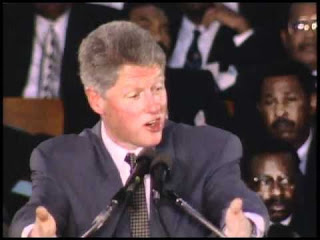
Clinton Library: 'President Clinton's Speech at Mason Temple Church (1993)'

Source:Clinton Library- President William J. Clinton (Democrat, Arkansas) 42nd President of the United States (1993-2001) 

"This is video footage of President William Jefferson Clinton speaking at the Church of God in Christ's Annual Convocation at the Mason Temple Church in Memphis, Tennessee.  Mason Temple Church was the site of Dr. Martin Luther King Jr's final sermon deliverance before being assassinated.  This footage is official public record produced by the White House Television (WHTV) crew, provided by the Clinton Presidential Library.

NOTE: MT01388 has minor frame damage at the top of the screen.

Date: November 13, 1993
Location: Mason Temple Church.  Memphis, TN." 

From the Clinton Library

President Bill Clinton at the Memphis Church of God in 1993. One of, if not the best speeches that President Clinton ever gave, at least in his first term, because it's so honest.

Source:Pics Bud- President William J. Clinton (Democrat, Arkansas) 42nd President of the United States (1993-2001) 
I saw this speech last week when I was watching a documentary about President Clinton and his Presidency. I might have seen this speech before, but I simply can't remember, but I already believe it's probably the best speech he's ever given at least as President of the United States. Even better than his first inaugural, or his 1992 or 2000 Democratic Convention speeches. 

All great speeches if you are not familiar with them, I suggest you watch or read them even if you don't like Bill Clinton, but someone who likes listening to good speeches. What made this speech great was the time that it was given, twenty five years after Martin Luther King was assassinated, not the anniversary of that assassination, this was November, 1993 MLK was murdered April, 1968, but twenty-five years after he was murdered. 

What else made this speech great was the simple honesty of it. He was attempting to speak for MLK, no one of course can do that we are simply talking about perhaps the greatest speaker this country has ever produced. What President Clinton was attempting to do was to layout what MLK would think of America Aad the African-American community twenty-five years later and the progress that it has made. But the challenges that still remain and what he died for and what he didn't die for. He said that fewer African-Americans as a percentage of the country lives in poverty and more live in the middle class. And are well-educated but still too many live in poverty and so-forth. 

The line in this speech that hit me the hardest not in a bad way, was when President Clinton said attempting to speak for Martin King: "I did not die to stop the violence from white people onto black people only to see black people killing other black people. I did not die to see that." And if you are an African-American I believe that's got to hit home that yes they've made progress, but we are still not at the mountaintop where Reverend King wanted African-Americans to join him.

Saturday, March 2, 2013

Brookings Institution: 'An Enduring Social Safety Net'

Source:Brookings Institution- talking about the U.S. Federal budget.

"Panel 1: President of the Natural Hazard Mitigation Association Edward Thomas; Professor of Health Care Policy in the Department of Health Care Policy at Harvard Medical School Michael Chernew; Professor of Economics at the Massachusetts Institute of Technology Jonathan Gruber; Malcolm Wiener Professor of Public Policy at the Harvard University John F. Kennedy School of Government Jeffrey Liebman; and Senior Fellow at the Center on Budget and Policy Priorities Paul Van de Water participate in a roundtable discussion on the nation's social safety net moderated by S.K. and Angela Chan Professor of Global Management at the University of California--Berkeley Haas School of Business Laura D'Andrea Tyson." 

Wednesday, February 20, 2013

Helmer Reenberg: President John F. Kennedy's- '51st Press Conference: March 6, 1963'


Source:Helmer Reenberg- President John F. Kennedy (Democrat, Massachusetts) giving his 51st press conference in 1963, at The White House in Washington.

"THE PRESIDENT: Good morning. Important steps are being taken in the Congress this week with respect to three major parts of the Administration's program and I want to take this opportunity to stress their importance to every American family.


President John F. Kennedy at The White House in 1963 promoting his economic agenda that included tax cuts, plus tax reform, as well as a job placement program for America’s youth. And he said that he expected Congress (a Democratic Congress) to act and pass his agenda.

Source:Helmer Reenberg- President John F. Kennedy (Democrat, Massachusetts) giving his 51st press conference in 1963, at The White House in Washington.

John F. Kennedy, when he became President of The United States in 1961 wanted to do a few things as it relates to economic policy. Go further in social insurance so more people could have access to affordable health care, especially senior citizens. In the areas of health insurance, but also more hospitals and health care professionals. But also in tax reform, lowering marginal tax rates where back in the early 1960s income tax rates ranged from 25-90%. Which was a drag on our economic growth, because Americans weren't seeing much benefit from their success and production.

So President Kennedy, wanted to lower taxes rates, because the Federal Government got a big chunk of what Americans were making. Which is why President Kennedy wanted to cut tax rates across the board. See more money in the economy, more take home pay for Americans to spend that money to see more economic growth. And these tax cuts served as an inspiration for the tax cutters on the Right in the late 1970s and early 1980s. That led to tax cuts at the state levels in the late 1970s and of course President Reagan's Economic Recovery Act of 1981.

But a Kennedy tax cut and a Barack Obama tax cut, are very different from a Reagan tax cut, or a George W. Bush tax cut. President Kennedy, didn't have this idea that tax cuts automatically paid for them self. And unlike supply siders he believed that deficits mattered. And that if you cut taxes, you should do that by paying for them. And he did that by cutting wasteful loopholes in the Federal tax code. Jack Kennedy, wasn't a Conservative as some on the Right like to suggest. And he wasn't a big welfare state Social Democrat that today's so-called Progressives like to believe he was. He was a  Liberal in the true sense. Not anti-government, but believed a limited government could help people who needed it help them self. 

You can also see this post on WordPress.

Tuesday, February 19, 2013

The Economist: 'The Next Supermodel'

Source:The Economist- The Nordic Viking? 
"SMALLISH countries are often in the vanguard when it comes to reforming government. In the 1980s Britain was out in the lead, thanks to Thatcherism and privatisation. Tiny Singapore has long been a role model for many reformers. Now the Nordic countries are likely to assume a similar role.

That is partly because the four main Nordics—Sweden, Denmark, Norway and Finland—are doing rather well. If you had to be reborn anywhere in the world as a person with average talents and income, you would want to be a Viking. The Nordics cluster at the top of league tables of everything from economic competitiveness to social health to happiness. They have avoided both southern Europe’s economic sclerosis and America’s extreme inequality. Development theorists have taken to calling successful modernisation “getting to Denmark”. Meanwhile a region that was once synonymous with do-it-yourself furniture and Abba has even become a cultural haven, home to “The Killing”, Noma and “Angry Birds...

Monday, February 18, 2013

Michelle Alexander: The New Jim Crow: Interview With Michelle Alexander

Source:Houston's Launch talking to author Michelle Alexander about her book The New Jim Crow.

"An interview by Anthony Perry (Youth Rights Activist) with Michelle Alexander (Author of The New Jim Crow) discussing the school to prison pipleline and how mass incarcaration has set many young people of color up for failure." 

Liberal Democrat

Liberal Democrat
Liberal Democracy